01 / THE PROBLEM
A small geometry inside a large assembly.
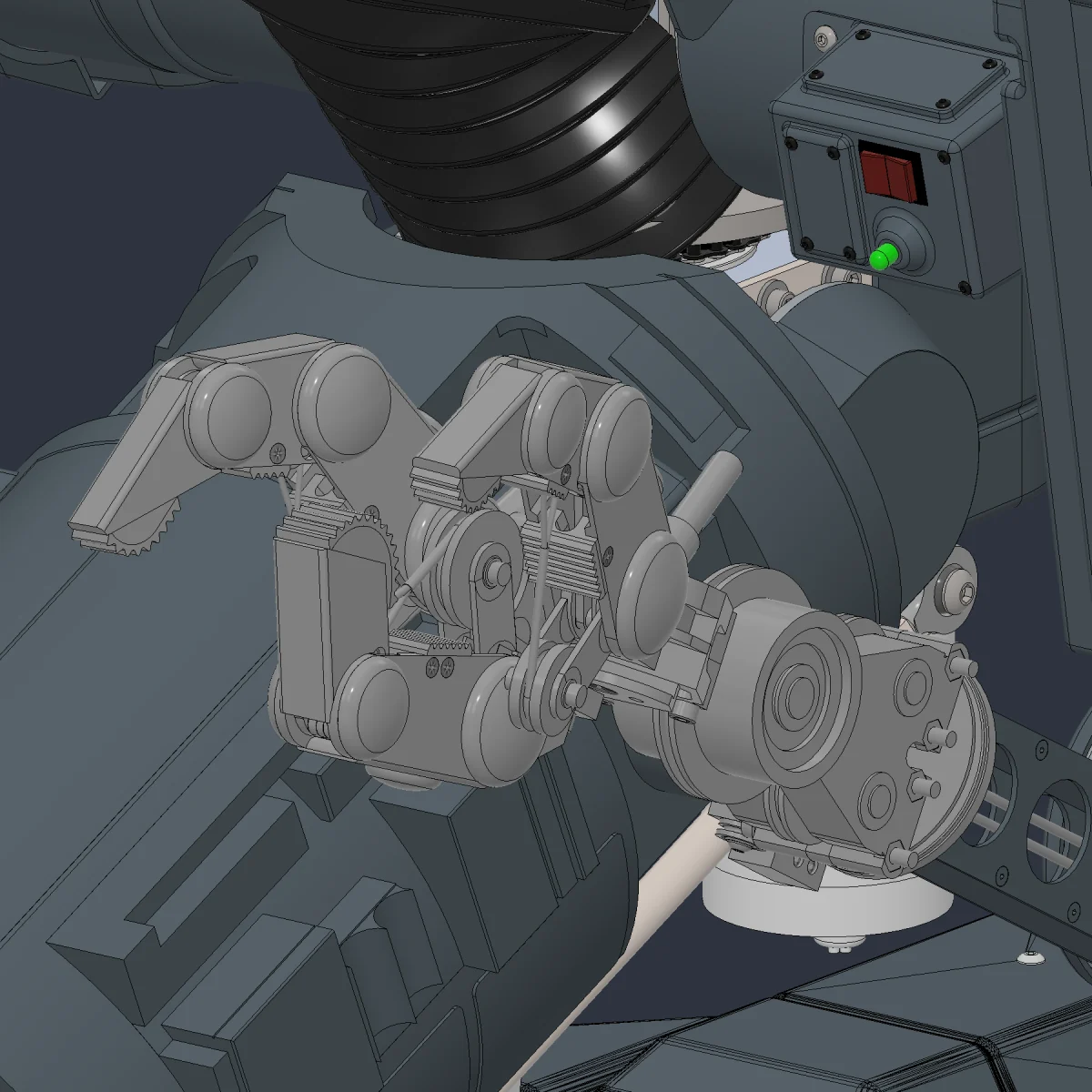
While working on Johnny 5’s hand, two lateral finger segments required a topology revision: the way faces and edges describe the solid in CAD. The defect was localised in small planar surfaces near the side seats.
The objective of this intervention was to preserve the component’s shape while making its geometric representation more consistent. A surface that looks correct can still require checks when it is imported, exported or reintegrated into an assembly.
This is a specific case within a broader effort that includes component modifications and complete redesigns relative to the OpenSAINT starting point. Here, the criterion was to retain the reference geometry while changing how the surfaces were divided.
02 / THE CORRECTION
The same shape, consolidated surfaces.
I worked on copies of the two components, unifying coplanar faces from valid source geometry. For each finger segment, the count went from 106 to 98 faces. The equivalence check compared the initial and corrected solids in both directions.
The Boolean difference was empty in both comparisons in the check performed. This supports geometric equivalence of the compared copies; the face count alone would not be sufficient evidence.
03 / BACK INTO THE ASSEMBLY
Verification continues after import.
The corrected geometries were integrated into revision U11 of the robot, retaining the previous versions in Fusion’s history. I then checked that the assembly reopened and that both components were solids with 98 faces each.
- Compare corrected geometry with the initial reference.
- Integrate both components into the assembly and retain the previous revision.
- Reopen the file to check that the change persists.
- Test the eight extreme combinations of the three selected CAD controls, followed by a return to the neutral pose.
The U11 test record reports a pass for these nine poses, no errors in the health check performed, and restoration of the neutral position. The check covers this chain and these model conditions.
04 / WHAT THE TEST SHOWS
Defining the scope of the results.
The results document the geometry correction, integration and checked kinematic behaviour in CAD. Loads, torques, material strength, tolerances and actual actuator behaviour remain to be verified.
Revision status
Correction integrated and checked in Fusion. The revision remains in development and has not been released for manufacture. The test does not constitute physical validation of the complete robot.
05 / THE METHOD TO KEEP
Retain, compare, reintegrate.
The useful outcome of this intervention is also the method: work on copies, define the comparison to perform and test the system again after a local change. This is the thread I want to maintain throughout the journal, from mechanics to control and AI integration.
Verification sources: local records of finger-segment integration, U11 assembly reopening and kinematic regression over eight extreme combinations plus the neutral pose. Images exported from the Fusion model.