Have you ever wondered why children are said to be the purest form of life?
Perhaps it’s because they possess an innate ability to marvel, free from the filters and prejudices that adult life tends to build over time. They judge what comes to them, both positively and negatively, they are unblemished, without stereotypes, and I would say certainly more capable than anyone else of distinguishing the "beautiful."
My father bought a piano when I was 7 years old. Occasionally, he would play it, but I never paid it any attention; in my mind, it was just a piece of furniture, and with the awareness I have today, I can understand why... Perhaps because my father, as a casual player, couldn’t extract all that the instrument had to offer. I hadn’t yet discovered classical music; it hadn’t yet made me vibrate, and so time passed, and I continued to overlook it for more than a year.
One day, my mother, who had to run some errands, took me to visit her sister, my Aunt Rossella. In the living room, she had a record player and underneath it, a cabinet full of records. She brought snacks for me and my cousin and picked a record. She placed it on the turntable and started playing it.
I was only 8 years old; what could I understand about music? The first notes began, it was Chopin's Fourth Ballade performed by Emanuel Ax.
I was literally stunned by the beauty that I couldn’t explain in words. It wasn’t just sound: it was a physical emotion, a force that seemed to shake the very air in the room. I remember my eyes were filled with tears, the goosebumps on my arms standing up from such beauty. Pure emotion, an emotion I had never thought I would feel before.
I begged my aunt to give me that record, and I literally wore it out on our home turntable. I listened to it so many times that the vinyl surface began to show signs of wear, but for me, that sound had become a safe haven, the beginning of a journey that would forever change my perception of the world. From that moment on, music ceased to be mere background noise and became the language with which to interpret every single nuance, every mood of reality.
I went to my father and asked if I could take piano lessons, and he, a lover of music, seeing the motivation in my eyes, could only smile and nod, understanding that this was not just a simple childhood curiosity, but the beginning of a genuine calling from above.
At that time, the internet didn’t exist, so finding a piano teacher wasn’t as simple as it is today: we had to rely solely on word of mouth, small ads in local newspapers, or flyers posted inside community centers. It was at the Don Bosco community center in Genzano that we found a flyer with the number of a piano teacher suggested by a priest: my first teacher, Fabio Salustri. We contacted him by phone, and after a brief conversation filled with anticipation, we scheduled our first meeting. The appointment was at the same community center where we found his number; in the hall, there was a multitude of people, as at that time, the realm of classical music and instrument study was still very popular.
I still remember almost all the words exchanged, but one phrase has remained indelibly in my mind: "Studying piano requires talent and a lot of sacrifice; I tell you this right away because I like to be clear from the start." The other children and teenagers in the room with me had worried faces; said like that, it sounded like a sentence, but I was calm because I felt that this challenge was not a limit, but the necessary condition to transform that passion into true art.
It was indeed a long journey, with the ups and downs of adolescence because I was never a bookworm; I liked going out with friends, dating girls, and enjoying life outside the walls of home; however, every time I returned to the keys, I felt that the sacrifice the teacher had spoken of was bearing fruit.
I took all the exams at the conservatory up to the diploma exam, where I performed the Fourth Ballade of Chopin.
The circle had closed at the point where it had opened. That’s why I am so attached to Chopin, because his music perfectly embodies that dualism between extreme technical effort and pure expressive freedom that I have experienced firsthand. It is my fixed memory of the emotion I carry within me from childhood, and every time I dive back into it, I relive that feeling of being a child again, as if it were a leap back in time.
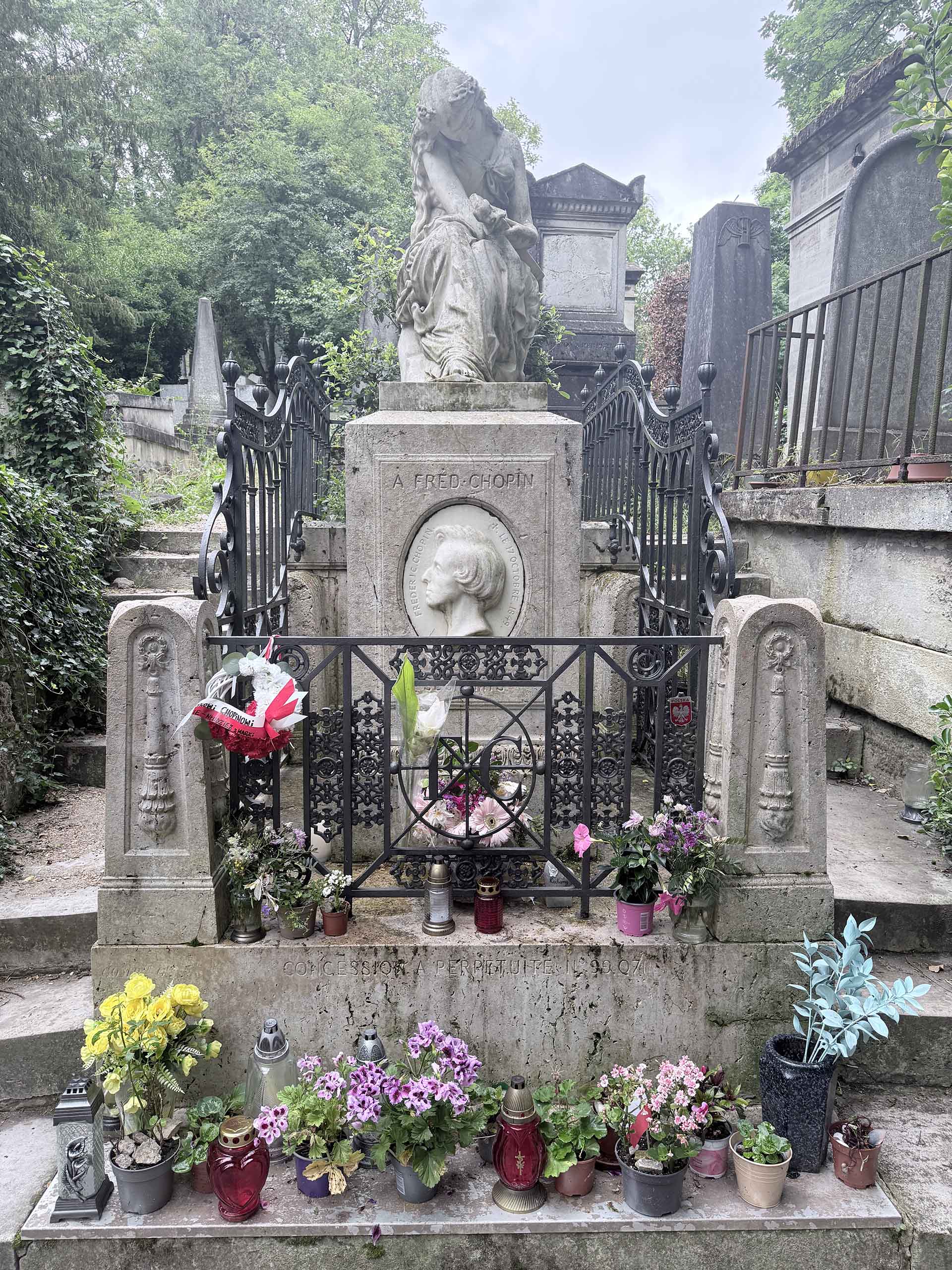
This summer, I was in Paris, and I couldn’t miss the chance to visit him at the Père Lachaise cemetery. It was an almost mystical experience: standing there in front of his grave made me feel as if I could perceive his energy, his romanticism. I didn’t want to leave, to the point that when we finally did, I had tears in my eyes again. "People like Chopin shouldn’t die; they should be exempt from death."
Yet in a sense, it is true; his music is here with us, immortal and vibrant, capable of defying time and continuing to speak directly to the soul of anyone who has the courage to truly listen to it. Unfortunately, today the world is full of wrong stereotypes; we should all return to being children or have the ability to project ourselves back into that state of innocence and lack of prejudice to understand the "beautiful." Only then can we finally allow ourselves to be overwhelmed by the purity of art, without filters or mental barriers that obscure its true essence.