Why choose a professional 3D printing service in Rome
We are in the era of the cloud and globalized services, so why should you care if your additive manufacturing partner has an office just a few steps away? Many think it's enough to upload an STL file to an online platform, pay by credit card, and wait for the courier to knock on the door in five days. That works for gadgets; it doesn't work for industry.
When we talk about industrial prototypes, geographical distance stops being a logistical detail and becomes a technical variable. If you order a part from a supplier on the other side of Europe and, due to a file misinterpretation or a tolerance issue, the component doesn't fit correctly, you've just wasted a week of work and several hundred euros in shipping. In Rome, however, if there is a problem, you get in your car, come to the lab, and we fix the bug in ten minutes by looking at the part together.
Then there is the issue of consultancy. A CAD file is almost never "perfect" for 3D printing on the first try. Some design with milling in mind, while others completely ignore support constraints or the orientation of the part within the build volume. Having a 3D printing service in Rome means being able to hold face-to-face optimization sessions. We can sit at the screen together, analyze the model, and decide whether to modify a thickness or change the orientation to prevent the part from collapsing during production.
The real added value, however, is rapid iteration. Prototyping is, by definition, a process of trial and error. Print, test, discover it doesn't work, modify, reprint. If every cycle of this loop has to pass through an international logistics center, your time-to-market explodes. Having a local partner transforms this process into an almost instantaneous dialogue. How much is it worth to your company to be able to test three different versions of the same component in 48 hours instead of two weeks?
Available Additive Manufacturing Technologies
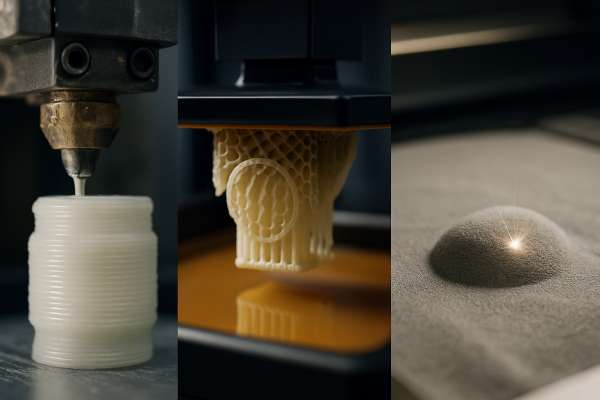
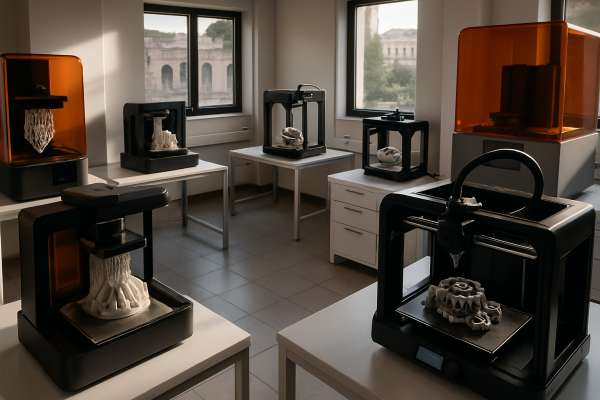
When searching for a 3D printing service in Rome, the first thing you'll encounter is a list of acronyms: FDM, SLA, SLS. For those who don't deal with engineering every day, they might seem almost interchangeable. They are not. Choosing the wrong technology means wasting time and budget on parts that, in practical terms, are useless.
FDM: The Workhorse for Functional Testing
Fused Deposition Modeling is the most common technology. Essentially, we melt a plastic filament and deposit it layer by layer. It's ideal if you need to verify the dimensions of a component or test a basic mechanical function without spending a fortune. But let's be honest: if you need a mirror finish or millimeter-perfect tolerances, FDM is not the right path. The layer lines are visible and surfaces are rough. It's great for a physical "sketch," less so for the final part.
SLA: When Detail is Everything
If the goal instead is surgical precision, we move to Stereolithography (SLA). Here, there is no melted plastic, but rather a liquid resin polymerized by a laser. The result? Smooth surfaces and details so fine that the human eye struggles to distinguish the layers. It is the mandatory choice for aesthetic prototypes, jewelry models, or medical components. Of course, resin parts tend to be more fragile than thermoplastic ones, but if you need to present a model to a client that looks like a finished product, SLA has no rivals.
SLS: Industrial Power
For those who need to produce mechanical components that must actually "work" under stress, there is Selective Laser Sintering. Here we use a powder (usually nylon) sintered by a very powerful laser. The huge advantage? No print supports are needed. You can create highly complex geometries and extremely robust parts, almost comparable to industrial plastic injection molding. This is the technology that transforms a prototype into a functional component.
So, which one to choose? The answer is simple: it depends on what the part needs to do. If it's just to see if it "fits in the hole," go with FDM. If it needs to be beautiful and precise, SLA. If it must withstand mechanical stress in a production environment, SLS. The true value of a consultant isn't telling you they can print everything, but telling you what not to print with a certain technology to avoid throwing money away.
Industrial Materials for Every Technical Need
Let's stop thinking of 3D printing as a hobbyist's game for printing colorful plastic figurines. When we talk about industrial prototyping, the material is not an aesthetic detail, but the variable that determines whether your component will survive a stress test or melt upon first contact with a solvent. Choosing the wrong material means wasting time and money on useless iterations.
For rapid prototypes—those used solely to verify dimensions or aesthetics—there are standard thermoplastics. PLA is convenient, but honestly, in an industrial context, it's almost useless due to its low thermal resistance. If you need something more robust without overcomplicating production, I go straight for PETG or ABS. The latter, while more challenging to print, offers the rigidity and impact resistance that a mechanical part truly requires.
Beyond Common Plastics: Nylon and Carbon
The real leap in quality happens when we enter the realm of high-performance materials. If you ask me for a part that needs to replace a metal component during a testing phase, I'll tell you about Carbon Fiber-filled Nylon. Here, we are no longer talking about "plastic," but composites with an impressive strength-to-weight ratio and dimensional stability that basic materials can only dream of. And for those who need flexibility? TPU is the answer. It is an elastomer that allows for the creation of gaskets or damping supports that won't tear after just two uses.
Then there is the world of technical resins, essential for those needing to simulate injection molding. These resins allow for micrometric precision and smooth surfaces, ideal for fit tests where every tenth of a millimeter counts. But be careful: not all resins are created equal. There is a massive difference between a standard resin that yellows in the sun and a technical resin designed to withstand aggressive chemical agents or high temperatures.
The question I pose to you is simple: do you know exactly what stresses your part will be subjected to? UV resistance, contact with industrial oils, heat cycles? If you don't have the answers, you're just guessing. And that is precisely where technical material analysis becomes an integral part of the consultancy process.
3D Printing Applications in the Business Sector
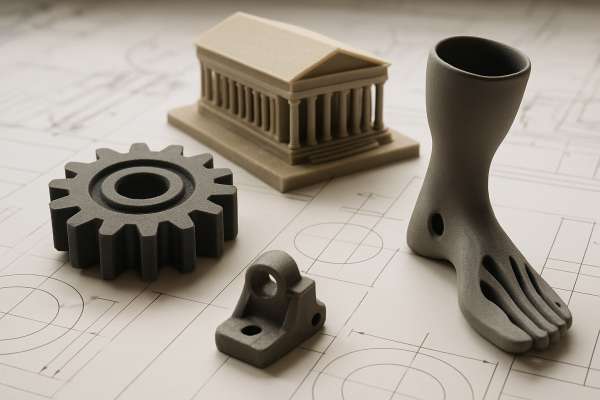
Let's step away for a moment from the narrative of "gadgets" or decorative objects. When we talk about 3D printing in a business context, we are talking about slashing iteration times and eliminating bottlenecks that cost thousands of euros in man-hours and delivery delays. But where exactly does this tip the scales?
Take the mechanical or automotive industries. Here, rapid prototyping isn't an optional extra; it's survival. Instead of waiting weeks for an external supplier to deliver a CNC-machined part, you can have a functional prototype in your hands within 48 hours. This means testing the fit between two components or verifying fluid flow without investing in expensive molds that would become obsolete at the first design error. Why risk thousands of euros on incorrect tooling when you can fail fast and cheaply with a printed part?
From the Construction Site to the Operating Room
In Rome, we have an incredible density of architecture firms that are finally understanding the value of precision physical models. I'm not talking about classic handmade scale models, but complex parametric models that allow the client to "touch" the space before a single stone is laid. It is a powerful sales tool, far more effective than a 3D rendering on a screen.
Moving to the medical sector, we enter a field where precision isn't just about quality—it's about safety. Creating personalized surgical guides or anatomical models based on CT scans allows surgeons to plan the procedure on the patient's actual anatomy before entering the operating room. Reducing surgery time and minimizing the risk of error? This is where technology becomes pure value.
Finally, there is an often underestimated area: tooling. Assembly jigs, positioning fixtures, or customized supports for the production line that were previously improvised in the workshop with scrap iron and rough welds. Printing these tools to measure means standardizing processes and reducing production waste. Are you sure your operators are using the best tools, or are they adapting to equipment that wasn't designed for that specific task?
The Workflow: From CAD File to Finished Part
Many people think that printing an industrial part is like using a document printer: you upload the file, press "print," and wait for the object to magically appear on the build plate. If you are looking for a professional 3D printing service in Rome, you know well that the reality is much grittier and more complex. The real work doesn't happen during the print, but before and after.
File Analysis and DfAM
It all starts with the CAD file. However, a model designed for milling or injection molding is almost never optimal for additive manufacturing. This is where DfAM, or Design for Additive Manufacturing, comes into play. When I analyze a project, the first question I ask myself is: "Can this part actually stand on its own?". I check minimum wall thicknesses, excessive overhangs, and points of fragility. If the file is wrong, printing quickly only means wasting material and time to produce a part that will break during the first test. I would rather lose an hour correcting the model's geometry than twenty hours of printing for a predictable failure.
Slicing: Where Quality is Decided
Once the design is validated, we move on to slicing. This isn't just a matter of software; it's an engineering choice. What orientation should the part have to maximize mechanical strength along the load axes? How much infill is needed to ensure rigidity without turning the object into an unusable brick? Adjusting slicing parameters means balancing precision, speed, and cost. Then, during the printing phase, monitoring is not optional. A thermal parameter off by just a few degrees can cause warping, rendering the part geometrically useless.
Post-Processing: The Last Mile
Once it comes out of the printer, the part is rarely "finished." Then comes the most tedious but fundamental phase: post-processing. Removing supports without leaving marks, sanding surfaces to eliminate the layer effect, or applying technical coatings and chemical treatments to make the component watertight or UV-resistant. This is where a prototype transforms from being a "plastic model" into an industrial component capable of being tested in real-world conditions. Without a careful finish, you're just looking at a raw part.
How to Optimize 3D Prototyping Costs
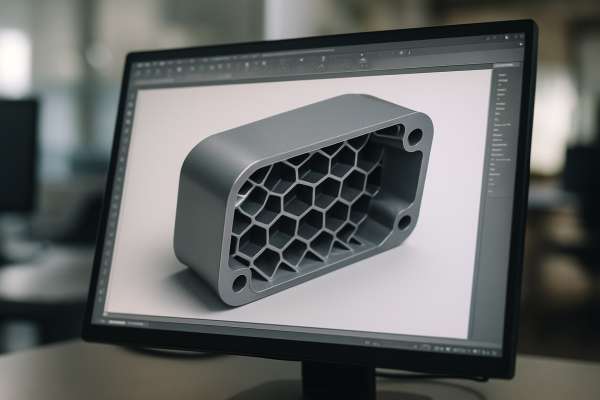
Let's be clear: many entrepreneurs view 3D printing as a magic wand for cutting costs, but if you approach the service naively, you risk spending far more than expected. The secret to avoiding budget burn isn't searching for the lowest quote — which often hides poor-quality materials or imprecise tolerances — but in how you design the part.
The first mistake I constantly see is an obsession with "solid" parts. Why print a massive block of plastic when you can use lattice structures, known as optimized infill? Reducing material volume without compromising structural rigidity isn't just about ecology; it's pure economic efficiency. Less material means less printing time and, consequently, a lower bill.
Aesthetic or Functional Prototype? Choose Wisely
Another common trap is demanding "perfection" at every stage. Do you really need a high-resolution resin part with a mirror finish just to test if a component fits correctly into its housing? No. In that case, an aesthetic prototype or a low-resolution PLA model is more than enough. Save the expensive materials and professional finishes only for the final functional prototype or the model intended for investors. Defining the purpose of the part before sending the file to your 3D printing service in Rome prevents you from paying for technical performance you don't actually need.
Then there is the matter of production logistics: nesting. If you need ten small components, don't ask for ten separate prints. Grouping parts into a single print session optimizes the build plate usage and reduces machine setup times. It's a simple concept, yet one often ignored by those without a technical background.
Finally, pay attention to your CAD files. A "dirty" file, with open surfaces or impossible geometries, leads to waste. And in additive manufacturing, waste is wasted time and material that someone has to pay for. Properly preparing the model isn't optional; it's the only way to ensure that the initial quote remains accurate until the part is delivered.
Criteria for Choosing the Best 3D Printing Partner in Rome
Choosing who will bring your projects to life is not a matter of who has the most expensive machine or the most modern website. If you are looking for a 3D printing service in Rome that is truly capable of supporting an industrial operation, you must look beneath the surface. The risk, unfortunately common, is relying on "hobbyist labs" masquerading as professional companies: great at printing an aesthetic model, but completely lost when it comes to mechanical tolerances or technical materials.
The first real litmus test is certifications and dimensional accuracy. Do not settle for a simple "yes, it's precise." Ask how the quality of the part is verified. Is there metrological control? What are the acceptable deviations for that specific technology? A serious partner will talk to you about microns and thermal stability, not "approximations." If the supplier cannot explain how they guarantee that hole A fits perfectly with shaft B, find someone else.
Then there is the matter of the portfolio. But be careful: I am not referring to a gallery of colorful photos on Instagram. I want to see real business projects. Have you solved a jig or fixture problem for an assembly line? Have you produced functional prototypes that have passed mechanical stress tests? Those who work with companies know that value lies not in the "beauty" of the piece, but in its ability to function in the real world.
An often underestimated but vital point is the management of intellectual property. Sending a CAD file via email to just anyone is professional suicide. A serious partner manages documents with precise protocols and does not hesitate to sign an NDA (Non-Disclosure Agreement) before even opening your file. Confidentiality is not an option; it is the foundation of a B2B relationship.
Finally, look at flexibility and lead times. In a product development cycle, a three-day delay in delivering a prototype can mean a week of downtime for the entire engineering team. You need someone who guarantees firm dates, not someone who tells you "let's see when I can get it in the queue." Production capacity must be scalable: a single piece for testing today, ten units for a pilot validation tomorrow.
Frequently Asked Questions (FAQ) about 3D Printing Services
Let's get straight to the point. Those looking for a 3D printing service in Rome are usually in a hurry or have a specific technical doubt they don't want to leave to chance. Here are the answers to the questions I hear most often during initial client consultations.
Which file formats should I send?
To put it simply: the standard is STL. It is the universal format that every machine reads without any issues. However, if you are working on more complex projects or require millimeter precision for mechanical assemblies, I prefer to receive STEP or IGES files. Why? Because STL files are meshes—composed of small triangles—whereas CAD formats maintain actual geometries. If you send me a "dirty" STL or one with holes in the geometry, we both waste time repairing the file before printing can begin.
How long does it take to get the prototype in hand?
It depends. If you need a 2-centimeter resin part, you can have it within 24 to 48 hours. If we are talking about a large structural component in carbon-filled nylon, the timeline increases due to the printing process and subsequent post-production (which is more than just "removing the part from the bed"). On average, for a serious industrial prototype, allow 3 to 7 business days. Anyone promising everything in a few hours without having seen the file is likely sacrificing quality or precision.
Can I produce series of parts or only single specimens?
3D printing was born for uniqueness, but today we have moved beyond that. For small batches—say 10 to 100 pieces—additive manufacturing is unbeatable because there are no plastic injection mold costs. However, if you are thinking about thousands of pieces, let's stop for a moment: it would be more cost-effective for you to switch to traditional molding. Part of my job is telling you when 3D printing stops being convenient for your needs.
I don't have the CAD file; can you create it?
Yes, but let's be clear: this is an engineering activity, not a printing one. If you have a sketch on paper or a physical part to replicate (reverse engineering), I or my team can handle it. But be aware: modeling an object that functions mechanically requires time and skills different from simply "clicking print." This is a separate service, essential if you want to avoid printing a beautiful object that doesn't fit together or cannot withstand stress.