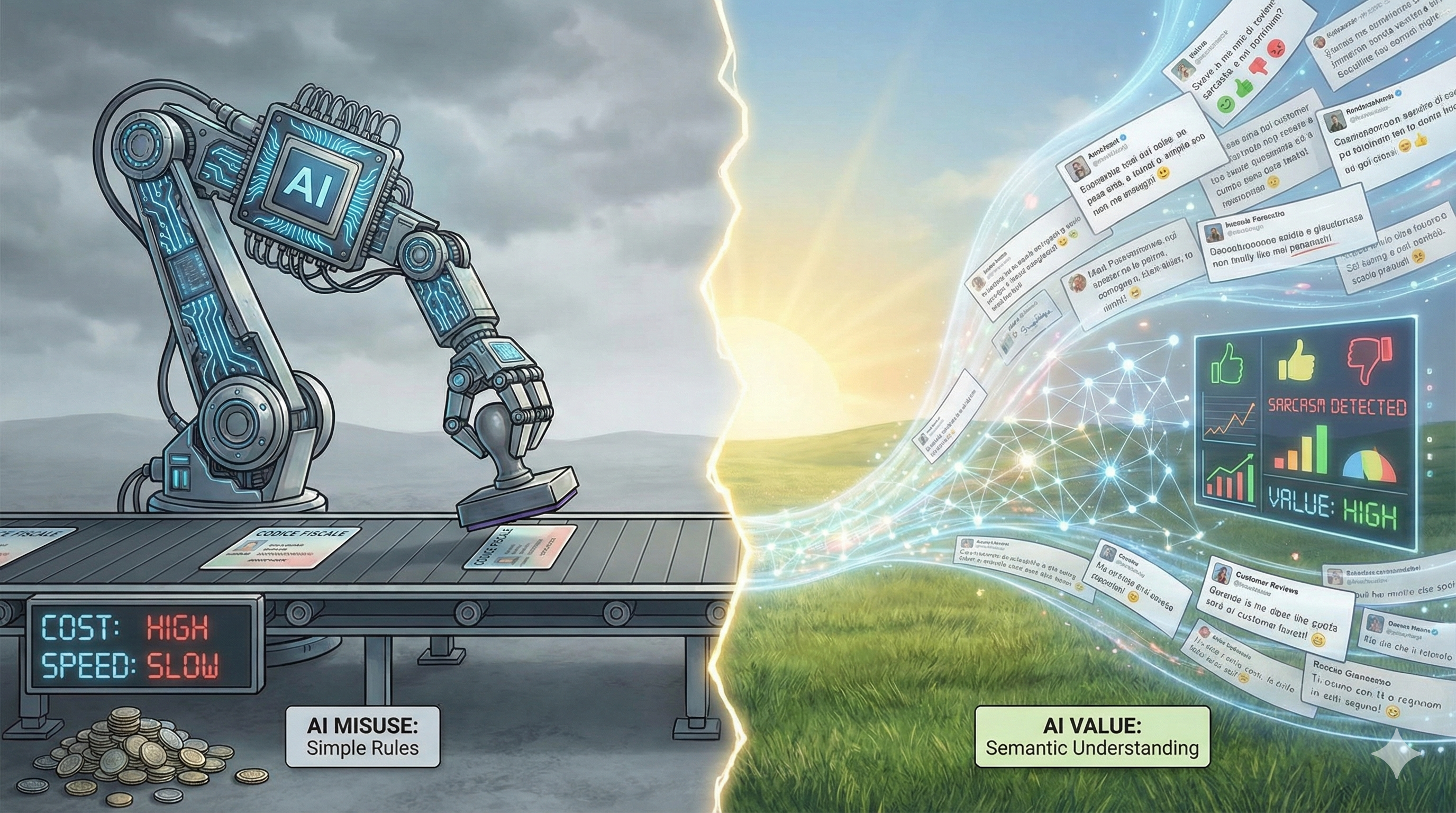
We are in a new era: that of AI, to the point where it has practically become a trend. Among entrepreneurs and general clients, it is the first thing requested when discussing a new project; as if a project that doesn't integrate it were automatically classified as a second-rate project.
Don't misunderstand the message... I am the first proponent of artificial intelligence! But at the same time, and perhaps even more strongly, I am a proponent of application logic.
As far as I'm concerned—and I'm sure I speak for all developers worthy of being categorized as such—AI should not be integrated just because it "looks cool"; it should be integrated when the context requires it, namely when we are dealing, mostly, with problems related to the concept of semantic understanding.

When not to integrate AI: a practical case study
A case of non-use.
Would you use AI for tax code validation?
Obviously, the answer is no!
In such a case, using AI is not only useless but would turn a fast resolution process—achievable through a simple deterministic algorithm—into a slow, cumbersome, and expensive process.
That is why, when I discuss these concepts with clients who ask me to integrate AI even where it isn't needed, I immediately talk to them about costs. Cost seems to be the magic word to use when trying to get an entrepreneur's attention.
What is needed to validate a tax code (codice fiscale)?
Verify that the length is correct: 16 characters
Verify the position of letters within the string
Check for omocodia (homocode)
Check the control character (checksum)
Verify the number pattern

Why, then, in this case must a deterministic algorithm be applied? Because we are writing a block of code that integrates 5 essential functions where the rules are fixed and known, the result they must return is boolean, there is no subjective interpretation (the tax code can only be valid or invalid), and probability is not required but absolute certainty of match/mismatch.
Verifying these 5 points, even with a low-performance language, would likely allow processing hundreds of thousands per second.
Why using AI would be a mistake
An AI model is certainly slower because I would have to write a prompt explaining to the model what to do. The prompt must be converted into tokens, sent to the model, and then I must wait for the response (inference time often exceeding one second) and process that response, typically in JSON, to evaluate the model's output. In this case, I would likely not be able to process more than 1 per second.
Furthermore, all of this, unless you have an AI-optimized server in your office, happens via paid services that have a pay-as-you-go cost.
If I had to verify the validity of a million tax codes using AI, this operation would take about 12 days at best, leaving the script running 24 hours a day. With a deterministic algorithm written in a compiled language like C, the processing would likely take less than a second; with high-level languages (Python, PHP), the time would increase to a couple of seconds.
If we were to use AI, beyond the time factor, we would have to consider at least 10 input tokens and 20 output tokens per request. For a million tax codes, we would have 10 million input tokens and 20 million output tokens which, even choosing the cheapest model (gpt-4o-mini), would generate a total cost of about 14 dollars for processing, compared to a cost of 0 for the deterministic algorithm.
It is clear that in a context like this, AI is not only useless, it is slower and more expensive.
When to Integrate AI: Effective Use Cases
Imagine having a website that sells products. Users leave reviews on the products, and I want to interpret the sentiment beyond the number of stars the user can leave.
Understanding the sentiment of a review cannot be done with a deterministic algorithm.
Why? Because we are talking about natural language, a domain where irony can mean the exact opposite of the stated sentence, a positive adjective can coexist with a negative judgment, context completely changes the meaning, or users write poorly by abbreviating, distorting, or skipping punctuation—or simply when human language is inherently ambiguous and subjective.
Fantastic product... If you like throwing money away
Integrating a sentiment evaluation through a deterministic algorithm would have to be based on a dictionary of positive and negative terms. In a sentence like the one above, the algorithm would interpret "fantastic" as positive and "throwing money" as negative; therefore, the final result of the analysis would be indeterminable.
An AI model trained on linguistic patterns understands sarcasm, recognizes sentence structure, and identifies the real intent. The result will be negative sentiment with high confidence. This is a type of understanding that is impossible to model with static rules.

In cases like this, AI is not a gimmick: it is the only technically valid and integrable tool for evaluating a reviewer's sentiment.
Therefore, AI is certainly a great ally, provided it is used where it is truly indicated. It must produce a benefit, not a limitation or an additional cost.