
What is AI Consulting for Businesses?

Let's start with a premise: if you think that AI consulting for businesses simply means installing the latest trendy software or configuring a GPT-4 instance for the marketing office, you are mistaken. That is technical setup; it is not consulting. True AI consulting in a B2B context is the art of understanding where an algorithm can actually move the needle on revenue or operational efficiency.
There is a vast difference between technical implementation and business strategy. The implementer will tell you that the model has very low latency and 98% accuracy. Useful, sure, but who cares if that model doesn't solve a real problem? Strategy, instead, asks: "Why are we using AI in this process? Are we automating an error or are we creating value?". Many companies today make the mistake of buying the technology before defining the problem. The result? They spend thousands of euros on licenses for tools that employees will never use because they don't integrate into the daily workflow.
My role, and the role of those who take this profession seriously, is to act as a bridge. On one side, there is the world of engineers and data scientists, who speak a language of parameters, tokens, and neural weights. On the other, there is the entrepreneur or manager, who speaks of margins, delivery times, and customer acquisition. An AI consultant must know how to translate between these two languages.
It's not about selling futuristic dreams, but about performing concrete analysis. It means looking at your messy, inefficient, and analog processes and understanding which part can be delegated to a machine without destroying the organization. It is bespoke work: there are no "out-of-the-box" solutions that work for everyone. If you are offered a standard pre-packaged bundle, you are talking to a software salesperson, not a consultant.
Why Invest in AI for Business Digitalization Today
We have reached a breaking point. For years, we have confused "digitalization" with purchasing a few management software packages or moving documents to a remote server. But that isn't transformation; it is merely digital archiving. True digitalization today happens through artificial intelligence because AI is the only technology capable of making sense of the monstrous volume of data that companies accumulate every day without knowing how to use.
Looking at the Italian and European markets, the risk of falling behind is no longer a remote possibility. While we are still debating whether AI is "dangerous" or "too complex," more agile competitors are already automating processes that used to require days of manual labor. Those investing now in AI consultancy for businesses aren't doing it to follow a trend, but to create a competitive moat. If your competitor can quote a project in ten minutes thanks to a model trained on their historical data, while you spend three days with Excel sheets and phone calls, you have already lost the client before even sending the offer.
Cutting Costs Without Cutting People
Then there is the issue of operational costs. I often hear that AI is meant to replace staff. I see it differently: it serves to eliminate the work that nobody wants to do. I am talking about data entry, invoice reconciliation, and managing repetitive tickets. When you shift these activities to an AI system, you aren't just reducing human error; you are freeing up human resources to do what machines cannot: think strategically and manage relationships. This is where resource optimization lies. How much does it cost your company to have a senior engineer doing data entry for two hours a day?
The Obsession with Customer Experience
Finally, there is the relationship with the customer. The era of the "average customer" is over. Today, hyper-personalization wins. I'm not talking about putting the customer's name in the subject line of an email—that has become trivial. I am talking about systems that predict what a customer will want before they even ask for it, based on behavioral patterns invisible to the human eye. AI allows you to scale attention to the individual: you can offer a tailored experience to ten thousand customers simultaneously. Is this possible with traditional methods? Absolutely not.
The Main Areas of AI Application in Business

Let's get practical: where does the marketing hype end and real value for a company begin? Often, the biggest mistake I see is searching for "the genius idea" instead of looking at the processes that drain time and energy from staff every day. Artificial intelligence should not be an isolated experiment, but a gear that fits into specific areas to unlock historical bottlenecks.
Automation: Beyond Simple Scripting
There is a vast difference between old RPA (Robotic Process Automation), which is limited to repeating mechanical actions, and integration with Generative AI. Where you previously had a bot moving data from an Excel sheet to a CRM without understanding what it was doing, today you can have systems that read a complaint email, understand the tone, extract order details, and suggest the best solution to the operator based on the customer's history. It is no longer just about "doing things faster"; it is about performing tasks with a level of judgment that previously required hours of human analysis.
Predicting Instead of Reacting
Predictive analysis is the real game-changer here for decision-making. It means stopping looking in the rearview mirror (monthly reports of what has already happened) and starting to look through the windshield. Whether it's predicting customer churn rates or anticipating a drop in demand in a volatile market, AI transforms raw data into warning signals or opportunities. But be careful: predictive models are only as good as the data you feed them. If your databases are messy or incomplete, AI will give you wrong answers with disarming confidence.
Logistics and Supply Chain: Ending Waste
Here, the impact on the bottom line is immediate. Optimizing the warehouse no longer means "filling the shelves to be safe," but using algorithms that cross-reference sales trends, supplier delivery times, and external variables. Reducing dormant stock and optimizing distribution routes is not just an exercise in efficiency; it is about freeing up working capital that would otherwise remain locked in a warehouse.
Marketing and CRM: Hyper-Personalization
Finally, the commercial side. Forget newsletters sent blast-style to the entire database. AI allows for real-time customer segmentation, proposing the right offer at the exact moment the user is inclined to purchase. The CRM stops being a static archive and becomes an active assistant that tells the salesperson: "Call this client today, because their online behavior indicates they are about to switch providers."
The Typical AI Consulting Journey: From Audit to Implementation
Many entrepreneurs think that implementing AI is like installing new management software: you buy the license, configure the parameters, and you're done. Wrong. AI consulting for businesses isn't about selling products; it's a process of applied engineering focused on business processes. If you start with the software without understanding the problem, you are simply spending money to automate inefficiency.
It all begins with the audit, which I call "gap analysis." I'm not interested in knowing which LLM model is currently the most famous; I want to see your data. Where is it? Is it clean, or is it a chaos of Excel files scattered across ten different computers? Without a solid database, any AI is just an expensive toy that hallucinates with confidence. In this phase, we uncover where the company is wasting time and where human error is costing you dearly.
The Complexity Trap and Quick Wins
The biggest risk is wanting to revolutionize the entire company in one fell swoop. That is a perfect recipe for failure. I prefer to focus on so-called "Quick Wins": simple, low-risk use cases that provide an immediate and visible impact. Perhaps we don't automate the entire supply chain right away, but instead start by optimizing support ticket management or data extraction from invoices. Why? Because the organization needs concrete proof to stop fearing AI and start trusting it.
Once the KPIs are defined — real numbers, not vague promises like "we will improve productivity" — I design the strategic roadmap. This is an attack plan that establishes what to do today, in six months, and in two years. It isn't carved in stone, because AI evolves every week, but it serves to provide direction.
Implementation is the final phase, where we get our hands dirty. This is where rigorous testing comes into play: does the AI respond correctly? Are the response times acceptable for the operator? Monitoring doesn't end with the release; an AI model must be nurtured, monitored, and updated, otherwise it degrades. Anyone who tells you that "once installed, the AI works on its own" is selling you smoke.
How to Choose the Ideal AI Consulting Partner
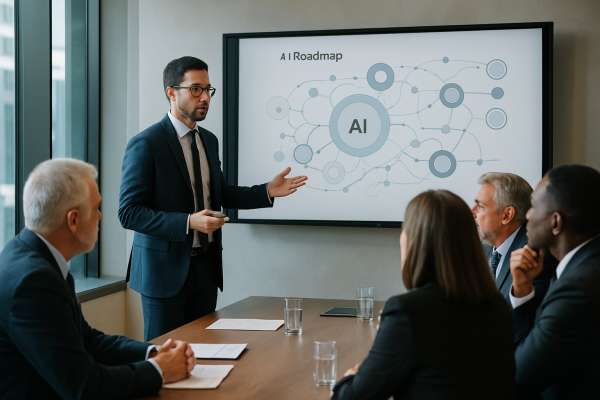
Choosing who should lead your company's technological transformation is a minefield. If you search for "AI consulting for businesses" on Google, you'll find yourself overwhelmed by agencies promising miracles and "digital revolutions" in four weeks. The truth? Many of these consultants know how to use OpenAI APIs well, but have no clue how a warehouse or an industrial production cycle actually works.
The first mistake I see is placing too much weight on technical expertise alone. Of course, having Python experts and data architects on the team is fundamental, but without a strategic vision, AI becomes an expensive toy. You don't need someone who knows how to build a complex model if that model doesn't solve a real problem that impacts your revenue or costs. Ask yourselves: does this partner understand how I make money, or do they just want to implement the latest tech trend so they can add it to their portfolio?
This is where vertical experience comes into play. AI is not a universal magic formula; applying it to logistics is a completely different world from applying it to legal marketing. A partner who knows the specific processes of your industry speaks your language and, above all, knows where the "dirty data" or typical inefficiencies of your market are hidden.
Then there is the issue of security, which is often brushed off with a vague "we are GDPR compliant." That is not enough. I want to see how they handle data anonymization and where the infrastructure physically resides. If the consultant cannot explain exactly who has access to your training data, change partners immediately.
Finally, beware of those who want to make you dependent on them forever. True high-value consulting aims for the transfer of skills. If after six months you are unable to manage the created workflows or if your internal team has just stood by without learning anything, you have just purchased an expensive black box, not a corporate asset. The ideal partner is the one who works toward becoming, over time, superfluous.
Challenges and Risks in AI Adoption
Let's be clear: implementing AI isn't like installing new management software or updating your CRM. It's not a linear process where you buy a license, configure the parameters, and everything magically starts working. The toughest challenge I encounter in my projects is almost never technical—it's human. Change Management is the real bottleneck. If people within the company perceive AI as a threat to their jobs or, worse, as an additional task imposed from above, they will boycott the tool. Even unconsciously. I've seen technically perfect systems end up forgotten because the people meant to use them preferred to stick with their "legacy" Excel sheet created ten years prior.
Then there is the issue of data. This is where things usually fall apart. Many companies think they are ready for AI, but when we open the databases, we find total chaos: duplicates, inconsistent formats, and gaps in time series. If you feed a model dirty data, you'll get wrong answers—only they will be wrong in a very convincing way. Data cleaning is the boring part, the part that no one wants to pay for or manage, but without data integrity, AI is just an expensive generator of corporate hallucinations.
Security and the Mirage of Immediate ROI
We cannot ignore security risks. Every AI integration point is a potential open door. Who controls the data flows? How do we prevent an employee from accidentally entering passwords or trade secrets into a prompt? Privacy is no longer just a matter of GDPR compliance, but of strategic survival. A leak of sensitive information via a poorly configured AI can cause irreparable damage to a brand's image.
Finally, there is the economic aspect. Many entrepreneurs ask me: "Simone, how long before I see a return on investment?". The truth is that AI ROI isn't always immediate or easily quantifiable in a short-term spreadsheet. There are setup, training, and maintenance costs that are often underestimated. The risk is investing in "hype" without a concrete goal, spending thousands of euros to automate processes that perhaps didn't even need to be digitized, let alone enhanced with AI.
Generative AI for Businesses: Beyond the Simple Chatbot

There is a widespread misunderstanding holding many companies back: the idea that generative AI is just a faster way to write emails or a chatbot that responds to customers with canned phrases. If you think ChatGPT is only useful for summaries, it's like looking at a Ferrari engine and wondering why it can't be used as a fan.
The real leap in quality happens when we stop using AI as an external toy and start integrating it into core processes. Take corporate Knowledge Bases, for example. Almost every company has thousands of PDFs, technical manuals, contracts, and Excel sheets scattered across folders that no one opens anymore. Transforming this chaos into an intelligent knowledge base means giving the AI the ability to "read" the company's entire information heritage to provide precise answers based solely on real, verifiable data. It is no longer a chat that invents answers, but an internal consultant who knows every single line of your operating manuals.
From Reporting to Autonomous Agents
Then there is the matter of content production and reporting. Spending hours compiling monthly reports by cross-referencing data from three different software programs is work that adds no value; it is pure administrative drudgery. Generative AI can automate data extraction and synthesize it into a document ready for management, leaving the human only with the task of validating the final result. But this is still the basic level.
The real frontier lies in autonomous AI agents. I am not talking about bots that answer questions, but software capable of executing actions. An agent can monitor inventory, notice that a component is running low, and autonomously draft a purchase order, sending a notification to the manager for approval. This is the transition from "AI that writes" to "AI that does."
Are you sure your current processes are optimized, or are you just trying to speed up inefficiency? Implementing artificial intelligence consulting for businesses today means exactly this: stopping the chatting with AI and starting to put it to work concretely on operational workflows.
Conclusions: The Future of Business Competitiveness in the Age of AI
Let's stop talking about artificial intelligence as just an additional "tool," a kind of utility similar to invoicing software or a CRM. This approach is already obsolete. The real challenge today is not integrating AI into existing processes, but evolving toward an AI-First model. What does this mean in practical terms? It means stopping the question "how can I use AI to do this thing faster?" and starting to ask "if I had this computing and analytical capacity, how would I completely redesign my business?".
There is a vast difference between a company that uses ChatGPT to write marketing emails and an enterprise that restructures its entire supply chain based on predictive models. The first is merely optimizing time; the second is changing the rules of the game. Those who ignore this leap risk finding themselves in a dangerous position: efficient, certainly, but irrelevant compared to a competitor who has reimagined their entire corporate architecture around data.
To avoid getting lost in the media noise, the steps are clear. First and foremost, clean your data: without a solid foundation, AI is nothing more than a generator of expensive hallucinations. Then, identify a real, concrete problem—something that keeps you up at night or eats into your margins—and test a solution on a small scale. You don't need full implementation by tomorrow morning; you need a prototype that works and delivers measurable value.
The risk of waiting for "the technology to mature" is that by the time it is perfect for everyone, the competitive advantage will have already vanished. The window of opportunity for those who want to lead the market instead of being subject to it is now. If you want to understand where AI can truly make a difference in your organization without wasting budget on useless experiments, contact me for a preliminary consultation. Together, we will analyze your processes and determine if you are ready for the leap or if we first need to bring order to your digital ecosystem.